..WERNER ERHARD

Current Academic Papers
available at Author Page:

Werner Erhard
Chapter 16, "Creating Leaders:
An Ontological / Phenomenological Model"

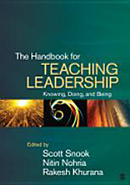
Handbook For Teaching Leadership: Edited by Senior Lecturer Scott Snook, Dean of Harvard Business School Nitin Nohria, and Dean of Harvard College Rakesh Khurana
|
| "Bringing together leading international scholars across disciplines for the dual purpose of chronicling the current state of leadership education and establishing a solid foundation upon which to grow the field, the text explores approaches to teaching leadership, the conceptual, theoretical and disciplinary roots upon which these approaches are based and what are the inherent strengths and weaknesses of each approach.
The Handbook is an invaluable resource to individuals, centers, institutes, and libraries to support the growing demand for courses in leadership and ensure that such courses and instruction are developed with multiple considerations and best practices in mind." From Sage Publications
Chapter 16, "Creating Leaders: An Ontological / Phenomenological Model", by Werner Erhard, Michael C. Jensen, and Kari Granger The quotes below are from the editor’s introduction of a chapter titled “Creating Leaders: An Ontological/Phenomenological Model” written by Werner Erhard, Michael C. Jensen, and Kari Granger in the book “The Handbook for Teaching Leadership: Knowing, Doing, and Being”. The book is edited by Harvard Business School’s Scott Snook (Senior Lecturer), Nitin Nohria (Dean of the Harvard Business School and George F. Baker Professor of Administration), and Rakesh Khurana (Dean of Harvard College and Marvin Bower Professor of Leadership Development).
The chapter described above by the editors is available for download at http://ssrn.com/abstract=1681682.
About the Editors Scott A. Snook is an Associate Professor of Organizational Behavior and Tukman Faculty Fellow at the Harvard Business School. Nitin Nohria is the Dean of the Harvard Business School and the George F. Baker Professor of Administration. He previously served as co-chair of the Leadership Initiative, Senior Associate Dean of Faculty Development, and Head of the Organizational Behavior unit. He is the author of numerous books and articles. Rakesh Khurana is the Dean of Harvard College and the Marvin Bower Professor of Leadership Development at the Harvard Business School. He is also Professor of Sociology at Harvard University and co-Master of Cabot House at Harvard College. He is the author of numerous important articles and books in the areas of leadership and management.
Publisher Sage Publishing: Founded in 1965, SAGE is a leading independent, academic and professional publisher of innovative, high-quality content. From the publisher: "The last twenty-five years have witnessed an explosion in the field of leadership education. This volume brings together leading international scholars across disciplines to chronicle the current state of leadership education and establish a solid foundation on which to grow the field. It encourages leadership educators to explore and communicate more clearly the theoretical underpinnings and conceptual assumptions on which their approaches are based. It provides a forum for the discussion of current issues and challenges in the field and examines the above objectives within the broader perspective of rapid changes in technology, organizational structure, and diversity."
LinksCreating Leaders: An Ontological/Phenomenological Model, Social Science Research Network Harvard Business School, Working Knowledge, First Look: February 28, 2012: Creating Leaders: An Ontological / Phenomenological Model National Library of Australia, The Handbook For Teaching Leadership: Knowing, Doing, and Being Institute of Coaching, McLean Hospital, Harvard Medical School, Recommended Reading: "The last twenty-five years have witnessed an explosion in the field of leadership education. This volume brings together leading international scholars across disciplines to chronicle the current state of leadership education and establish a solid foundation on which to grow the field." Academy of Management: Learning & Education review of The Handbook For Teaching Leadership: Knowing, Doing, and Being Being A Leader and The Effective Exercise of Leadership: An Ontological / Phenomenological Model Stanford Library Services: Bringing together leading international scholars across disciplines for the dual purpose of chronicling the current state of leadership education and establishing a solid foundation upon which to grow the field, the text explores approaches to teaching leadership, the conceptual, theoretical and disciplinary roots upon which these approaches are based and what are the inherent strengths and weaknesses of each approach. The Handbook will be an invaluable resource to individuals, centers, institutes, and libraries to support the growing demand for courses in leadership and ensure that such courses and instruction are developed with multiple considerations and best practices in mind. Research Gate - Creating Leaders: An Ontological / Phenomenological Model The Handbook For Teaching Leadership UCLA - The Handbook For Teaching Leadership Creating Leaders: An Ontological/Phenomenological Model: Harvard Business School What is Leadership: The Ontological / Phenomenological Model Being a Leader and The Effective Exercise of Leadership Creating Leaders: A Pilot Pre/Post Evaluation of an Ontological/Phenomenological Model
Erhard, Jensen and Granger's Chapter has been cited in the following academic publications:Management Education for the World: A Vision for Business Schools Serving People and the Planet, by Katrin Muff, Thomas Dyllick, Mark Drewell, John North, Paul Shrivastava, Jonas Haertle The Needs of Participants in Leadership Development Programs: A Qualitative and Quantitative Cross-Country Investigation, by William A. Gentry, Regina H. Eckert, Vijayan P. Munusamy, Sarah A. Stawiski, and Jacob L. Martin in the Journal of Leadership & Organizational Studies The Science of Leading Yourself: A Missing Piece in the Health Care Transformation Puzzle, by Wiley W. Souba in the Open Journal of Leadership Critical Leadership and Music Educational Practice, by Patrick K. Schmidt in the journal Theory Into Practice Faculty Development for Leadership and Management, by Tim Swanwick and Judy McKimmin the book Faculty Development in the Health Professions The PRME Curriculum Tree: A Framework for Responsible Management Education in Undergraduate Business Degree Programmes, by Alexander Hope; In book: Redefining Success: Integrating Sustainability into Management Education, Edition: 1st, Chapter: 4, Publisher: Routledge, Editors: Patricia M. Flynn, Tay Keong Tan, Milenko Gudić, 2018 Deregulation of the Downstream Sector of the Nigerian Petroleum Industry: The Role of Leadership, by Godfrey Nkogbu, European Journal of Business and Management. 7. 35-46; 2015 Developing globally responsible leaders in business schools: A vision and transformational practice for the journey ahead, by Katrin Muff, The Journal of Management Development.; 2013 Are You Ready to Be a Leader? The Ontology of Leadership, by Juan Carlos Puyana MD, Timothy Billar MD. In Leadership in Surgery; 2015
|